
About

Material Crisis

A System under Pressure

The construction sector is among the most resource- and emission-intensive industries worldwide. It accounts for around 38% of global CO₂ emissions and consumes roughly half of all raw materials extracted globally. Large quantities of primary resources are extracted, processed using significant amounts of energy, and discarded after comparatively short periods of use. This linear system is increasingly reaching its limits.

Conventional construction methods are not only energy-intensive, but often designed for limited life cycles. Complex layered assemblies may perform technically, yet they are difficult to dismantle or repair without replacing entire components. At the same time, synthetic materials and surface treatments can negatively affect indoor air quality during the use phase. The result is buildings that are neither materially nor structurally oriented toward durability, health, or circularity.

Economically, this model is becoming increasingly fragile. Dependence on global supply chains, rising energy prices, and volatile raw material markets continue to drive construction costs, with tangible consequences for developers and occupants alike. The widespread perception that ecological construction is inherently more expensive largely reflects a temporary snapshot. Price differences today are often the result of missing economies of scale in production. At the same time, energy-intensive manufacturing, international transport, and resource scarcity are structurally becoming more expensive. The economic conditions are shifting.

If construction is to remain affordable in the long term, it requires materials that systematically respond to these developments: circular instead of linear, durable and repairable instead of bonded and short-lived, regional and low-energy in production instead of internationally dependent and emission-intensive.

A New Practice

Our Contribution to Change

We are convinced that the transition in construction begins with materials. Regional natural building materials provide the foundation for a building practice that is ecologically sound, structurally robust, and economically stable over the long term.

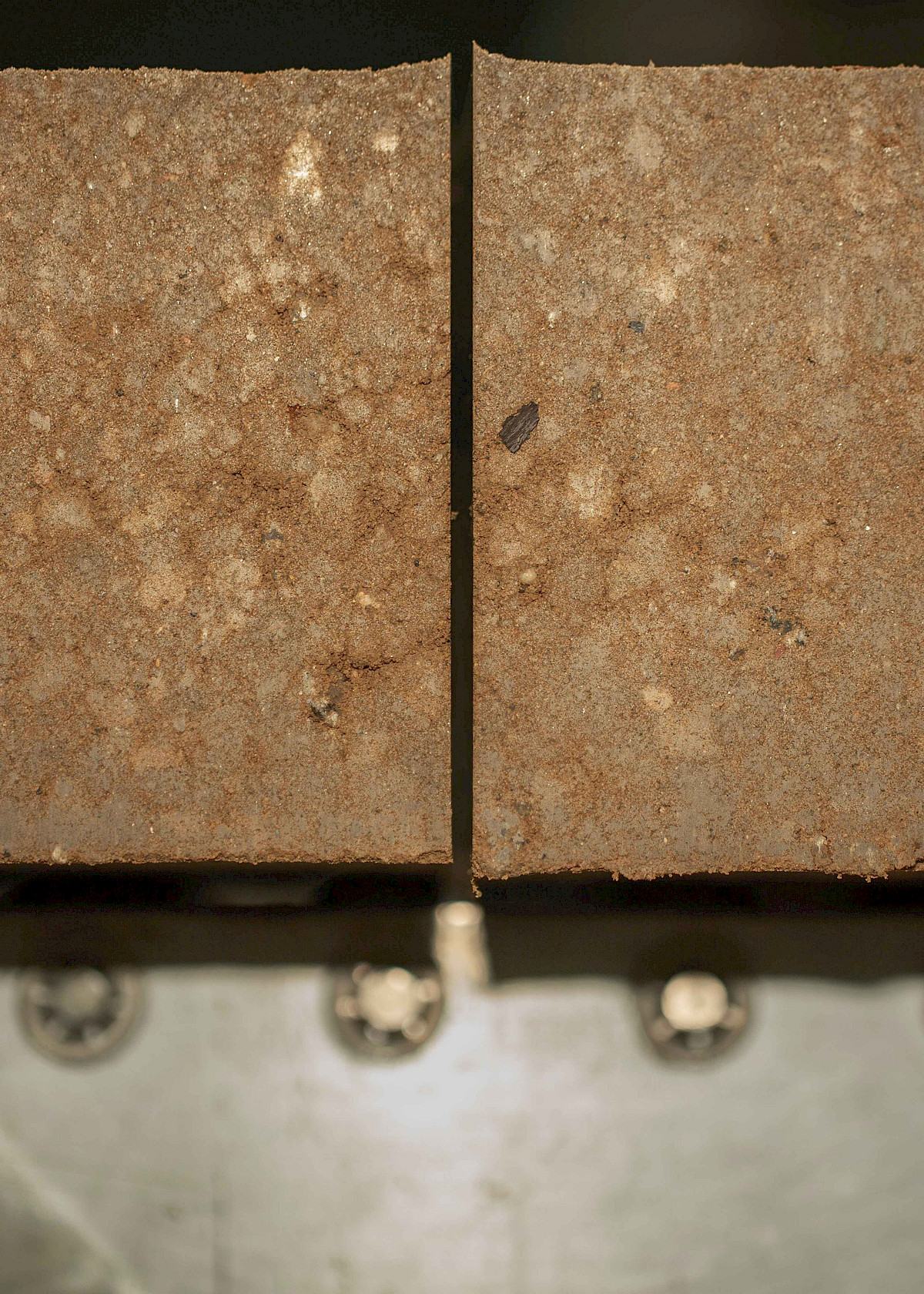
Earth plays a unique role in this context. As a natural product of rock weathering, it is available almost everywhere. It requires little processing energy, is vapor-permeable, fully reusable, and enables durable, repairable constructions. When applied correctly, it forms building components that are consistently designed for longevity.

At the same time, this very material accumulates daily in large quantities as excavated soil from construction sites. In many cases, this earth is ideally suited for the production of high-quality building materials. It is considered waste primarily because there has been no market for it. What has been missing is the consistent translation of this resource into standardized, scalable products.

This is where earthbound’s work originates. We analyze soils mineralogically, develop robust recipies, and transfer them into automated manufacturing processes. The result is high-performance building materials made from locally excavated soil, predictable, reproducible, and economically viable.

Our goal is to bring earth-based building materials back from niche applications into mainstream construction practice as a healthy, affordable, and circular building material.

Team

Image

Albrecht Dobelstein

Project Associate

Image

Christian Gäth

Co-Founder

Responsible for the material and process development of earthbound’s products as well as the setup of production. With a background in architecture and material research, he translates material properties into robust formulations and scalable manufacturing processes. His focus is on making earthen building materials reproducible and industrially-scalable reliable.

More
Less

Image

David Janotta

Co-Founder

Leads finance, partnerships, and operations. He steers the company’s economic development and establishes the operational structures for market entry. His focus is on building financial stability and the structural foundations required for the broad adoption of circular building materials. He holds an MBA and a Master’s degree in Innovation Management.

More
Less

Image

Micha Kretschmann

Co-Founder

In charge of the conceptual and application-oriented product development as well as the setup of production. With a background in architecture and material research, he drives the systematic development of product ideas from research and building practice. His focus is on developing new constructive and design benchmarks for circular architecture through earthbound’s products.

More
Less

We are currently looking for a working student to join our design and marketing team. We also welcome unsolicited applications at any time and regularly offer mandatory internships lasting three to six months. Send us your application documents as a PDF (max. 10 MB) to team@eb.eco.